There is a quiet misunderstanding that runs through how people interact with the world: the idea that clarity only exists in response to something external. That we define ourselves based on what is required, expected, or accepted.
But that is not clarity.
That is reaction.
True clarity does not come from outside structures. It comes from within—before any interaction takes place.
Most systems, institutions, and frameworks don’t carry power on their own. They operate because people participate in them, often without fully understanding themselves or what they are agreeing to. When someone lacks clarity, they lean on structure. They look outward for direction. And over time, that creates the appearance that the structure itself holds authority.
But it doesn’t.
What gives anything weight is not the system—it is the participation within it.
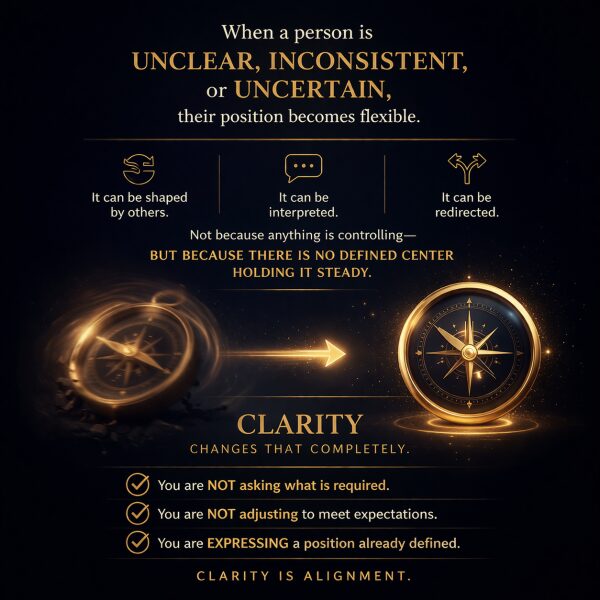
When a person is unclear, inconsistent, or uncertain, their position becomes flexible. It can be shaped, interpreted, or even redirected by others. Not because anything is inherently controlling, but because there is no defined center holding it steady.
Clarity changes that completely.
When you operate from a place of clarity, you are not asking what is required. You are not adjusting yourself to meet expectations. You are expressing a position that is already defined.
That expression becomes the foundation of how you move, speak, and engage.
It is not about resistance.
It is not about opposition.
It is about alignment.
A clear person does not need to argue their position. They don’t need to reinforce it repeatedly. Their consistency does that for them.
Every action reflects the same center.
This is where expression becomes important—not as performance, but as confirmation.
When you write something, sign something, or mark something, you are not completing a task. You are leaving a record of your position. That record should not be vague, assumed, or open to interpretation. It should reflect exactly where you stand.
That’s why consistency matters.
Not because anything requires it—but because without it, clarity dissolves.
If your words say one thing, your actions another, and your expression something else entirely, then what exists is not clarity. It is fragmentation. And fragmentation is where confusion enters.
But when everything aligns—your understanding, your words, your actions—then nothing is unclear.
There is no space for assumption.
No space for misinterpretation.
No space for uncertainty.
What you express stands on its own.
Some people add layers to this expression. A signature. A mark. A seal. A thumbprint. Not because these things are required, but because they choose to represent themselves fully in what they do.
For them, these are not just symbols. They are reflections:
The seal becomes a witness of identity.
The signature becomes the expression of nature.
The mark becomes presence.
Together, they are not about validation—they are about alignment.
And alignment carries a different kind of weight. Not forceful, not imposed—just clear.
That is something systems cannot create or take away.
Because it doesn’t come from them.
It comes from the individual.
This is where the conversation often gets misunderstood. People assume that clarity is about navigating systems correctly, following rules, or avoiding mistakes. But clarity is not about managing something external.

It is about knowing yourself well enough that wherever you step, your position remains the same.
You don’t adjust it depending on the situation.
You don’t weaken it to fit expectations.
You don’t strengthen it to appear certain.
It is already defined.
And because it is defined, it becomes consistent.
That consistency is what removes friction—not because the world changes, but because you are no longer moving in a way that creates confusion.
You’re not guessing.
You’re not reacting.
You’re not negotiating your own position.
You are expressing it.
And that expression, when it is clear and consistent, stands on its own.
Not because anything enforces it.
Not because anything validates it.
But because it is complete.