Most people hear terms like Divine Law and Natural Law and immediately place them into something abstract, distant, or philosophical.
But they don’t have to be.
In fact, both can be understood in a very simple, practical way — something you can observe in everyday life.
One of the easiest ways to see it is through a game most people already understand:
Chess.
The Structure Comes First
Before a single move is made in chess, something already exists.
There is a board.
There are pieces.
There is an order to how everything is set up.
More importantly, there is a consistency to how the game works. The pieces move in specific ways. The structure doesn’t change based on opinion. It doesn’t adjust based on emotion. It simply is what it is.
This is a good way to understand Divine Law.
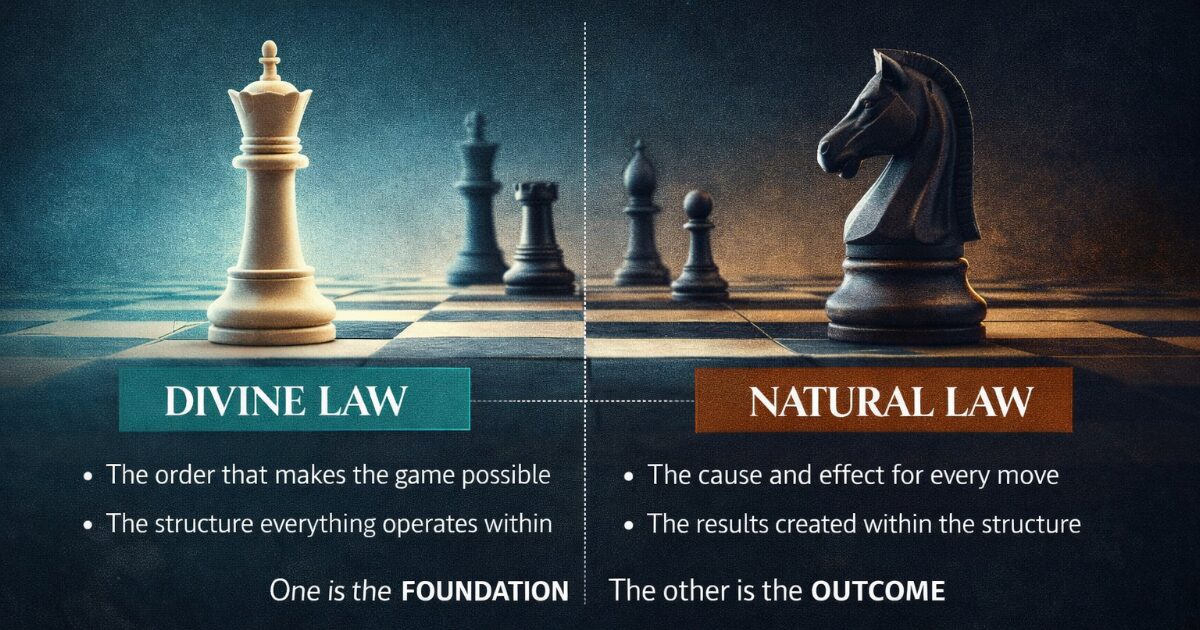
Divine Law is not just a list of rules written down somewhere. It’s the underlying order that makes everything possible in the first place. It is the reason there is a structure at all.
Without that order, there is no game.
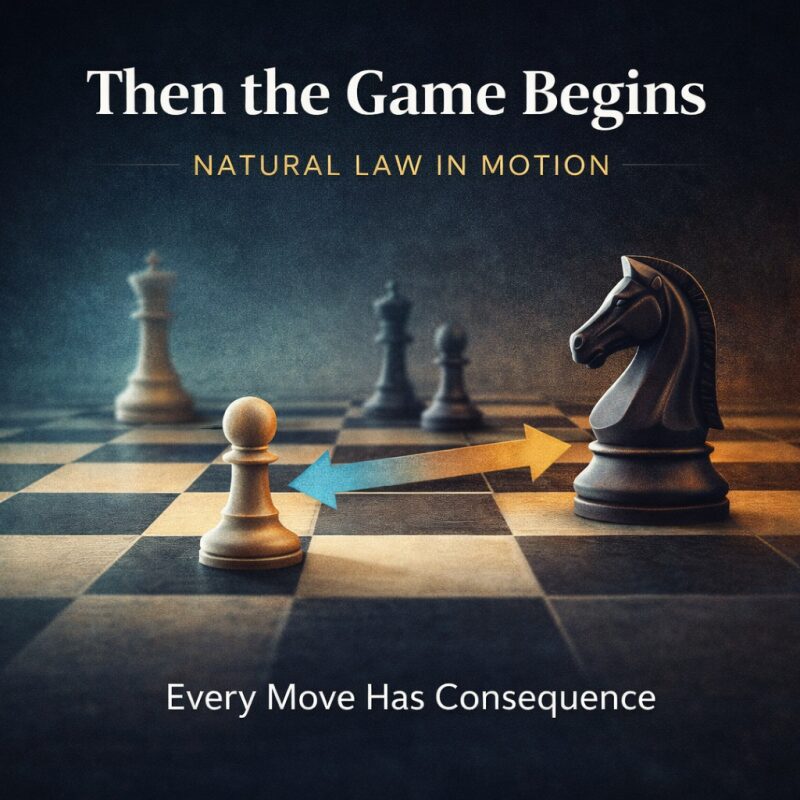
Then the Game Begins
Once the structure is in place, the game starts.
Now, every move matters.
You move a piece — something changes.
Your opponent responds — something else changes.
Positions shift. Opportunities open and close.
Nothing happens in isolation.
This is where Natural Law comes into play.
Natural Law is the cause and effect that unfolds within the structure. Every action creates a result. Every decision leads somewhere. And those results are not random — they are connected to the moves being made.
You cannot make a move without consequence.
Knowing vs. Applying
Here’s where many people get tripped up.
You can know the rules of chess and still lose the game.
You can understand how each piece moves, memorize strategies, and still find yourself in a losing position if your decisions don’t align with what’s actually happening on the board.
The same applies here.
You can talk about structure, principles, or even “law” — but if your actions are not aligned with cause and effect, the outcomes will reflect that.
On the other hand, someone may not be able to explain the rules in detail, but through observation and awareness, they begin to make better moves. Over time, their results improve — not because they are guessing, but because they are aligning with how things actually work.
You’re Not Playing Alone
Another important part of this understanding is recognizing that you are not the only one making moves.
In chess, there is always another side.
In life, there are other people, other systems, other forces — all interacting at the same time.
This means outcomes are shaped not just by your decisions, but by how those decisions interact with everything else in motion.
You may make a strong move, but if it doesn’t account for the full board, the response can shift the entire direction of the game.
This is why awareness matters.
Not just of what you’re doing — but of what’s happening around you.
Bringing It Together
When you step back and look at it clearly, the distinction becomes simple:
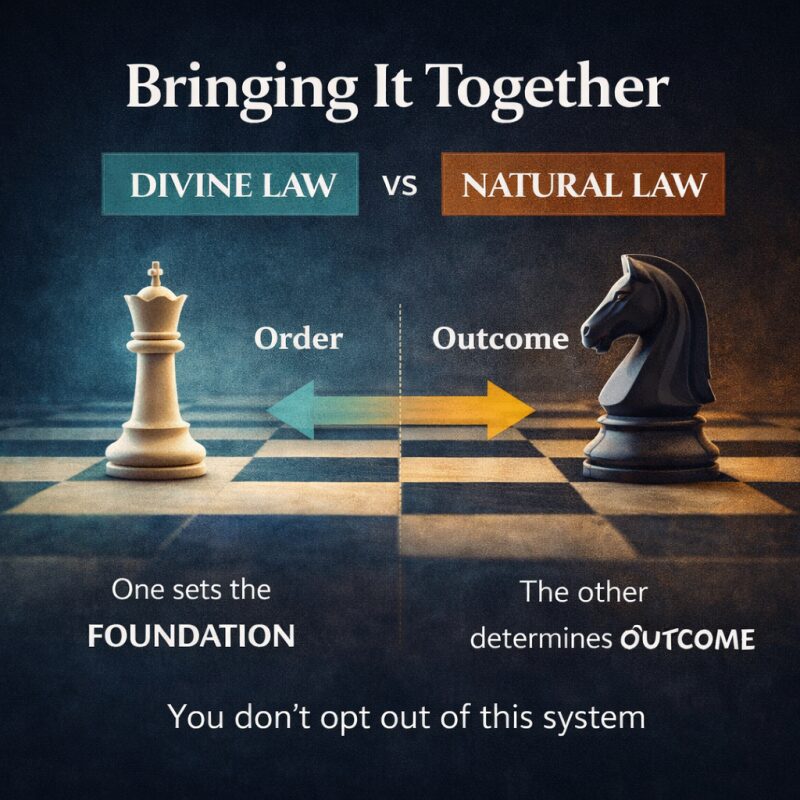
Divine Law is the order that makes the system possible.
Natural Law is how results unfold within that system.
One sets the foundation.
The other determines the outcome.
You don’t get to opt out of either one.
You are always operating within a structure, whether you recognize it or not. And every move you make carries a consequence, whether you intended it or not.
Why This Perspective Matters
This way of looking at things removes a lot of confusion.
It brings everything back to something practical:
- Understand the structure you’re operating in
- Become aware of how your actions create results
- Make better moves over time
There’s no need to overcomplicate it.
You don’t have to turn it into something mystical or unreachable. It’s something you can observe, test, and refine through experience.
Just like chess.
The more you pay attention, the clearer the patterns become. The more intentional your moves are, the more consistent your outcomes begin to be.
And over time, what once felt complex starts to feel natural.
Final Thought
You don’t need to master everything at once.
You just need to start seeing the difference between the structure… and your moves within it.
Because once you do, the game begins to make sense.
And when the game makes sense, your position starts to change.