The words “republic” and “democracy” get used all the time, often as if they mean the same thing. Most people hear them, repeat them, and move on without ever really stopping to ask what they actually describe. But the truth is, they are not the same—and understanding the difference brings a level of clarity that changes how you see the system as a whole.
In the United States, this distinction becomes even more important when you look at it through a deeper lens: the difference between form and substance.
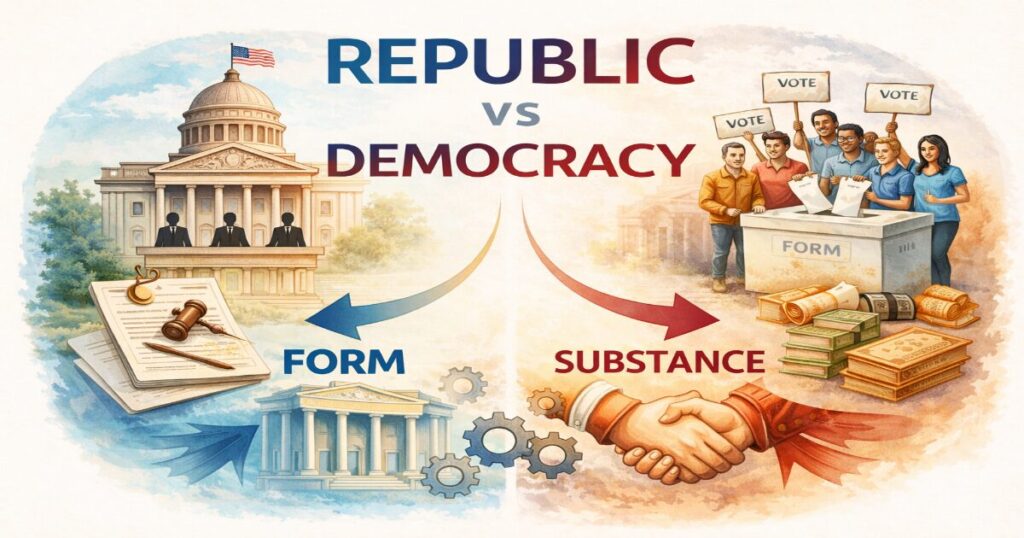
At its core, a republic is about structure. It describes how governance is organized. In a republic, people do not directly create most laws themselves. Instead, they elect representatives who act on their behalf. Those representatives write, debate, and pass laws within a defined legal framework, guided by a constitution. Authority is delegated, and the system operates through that delegation.
That is the form.
Democracy, on the other hand, describes how people participate within that structure. In its pure form, democracy would mean that people vote directly on laws and decisions. In practice, what most people experience is more limited—they vote in elections and, in some cases, on specific measures. Voting becomes the primary way individuals interact with the system.
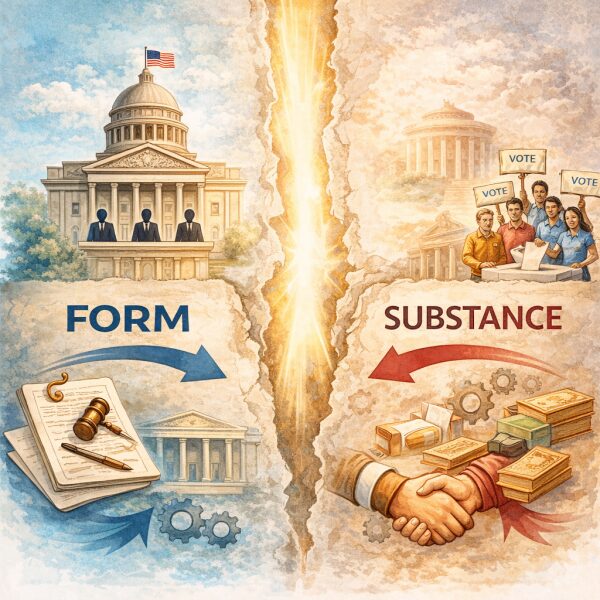
That is also part of the form.
And this is where many people stop. They understand the labels. They recognize the structure. But what is often missing is an understanding of substance—how things actually function beyond what is written or described.
Substance is not about what the system is supposed to be. It is about what happens in operation.
When people say “we live in a democracy,” they are usually referring to the ability to vote. Voting feels direct. It feels personal. It feels like participation. But voting does not create most laws. It determines who will be in the position to create them. Between that vote and the final outcome, there is a layer of activity that is not directly controlled by the individual voter.
That layer is substance.
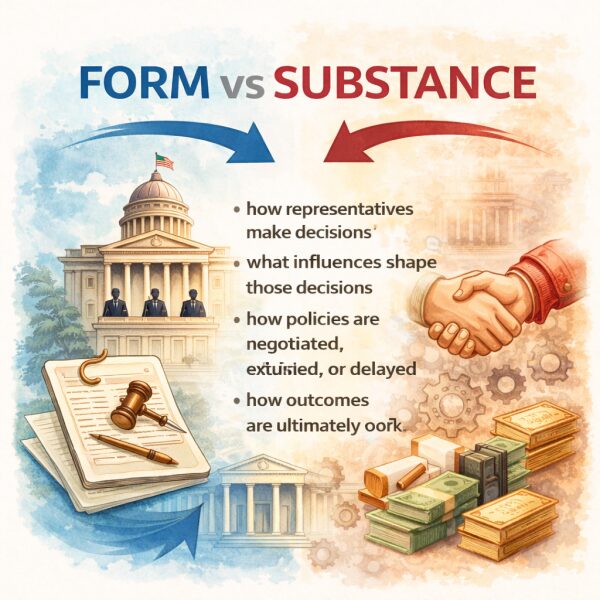
It includes:
- how representatives make decisions.
- what influences shape those decisions.
- how policies are negotiated, adjusted, or delayed.
- how outcomes are ultimately formed.
Once you begin to see this, the system becomes clearer.
A republic defines the framework. Democracy provides a method of participation. But substance is where the real movement happens. It is where decisions are shaped, not just where they are described.
This is why people can experience a disconnect.
On the surface, the form appears clear: people vote, representatives are chosen, laws are created. But in substance, the process is more complex. Representatives operate within environments that include competing interests, institutional structures, and ongoing negotiation. The path from participation to outcome is not always direct.
This does not mean the system is broken. It means the system is layered.
Understanding the difference between form and substance allows you to hold both realities at the same time. You can recognize the structure without assuming that structure tells the whole story. You can value participation without expecting it to operate in a straight line.
A simple way to see it is this:
- Form tells you how the system is designed.
- Substance shows you how the system actually operates.
- Both are real. Both matter.
And once you understand that, many of the common questions begin to resolve themselves. Why do some laws exist that you never voted on? Because lawmaking happens through representation. Why does voting feel important but sometimes limited? Because it is one part of a larger process, not the entire mechanism. Why can outcomes feel distant from individual expectation? Because decisions are shaped within layers beyond the initial vote.
This perspective brings the conversation out of slogans and into understanding.
It also connects to something deeper. The concept of form and substance is not just a political idea—it is a foundational principle in legal thinking. What something is called, and how it is structured, matters. But what actually happens in practice matters just as much, if not more. The law itself often recognizes this distinction, especially when determining how something should be interpreted or applied.
So when you look at a republic that uses democratic processes, you are not just looking at a system of governance. You are looking at a structure (form), a method of participation (democracy), and a lived operation (substance).
In the end, the difference is simple, but powerful. A republic is the framework. Democracy is how people participate within that framework. And substance is how everything actually unfolds in practice.
When those three are understood together, the system is no longer abstract. It becomes something you can see clearly, think about clearly, and engage with more intentionally.
And that is where real understanding begins.