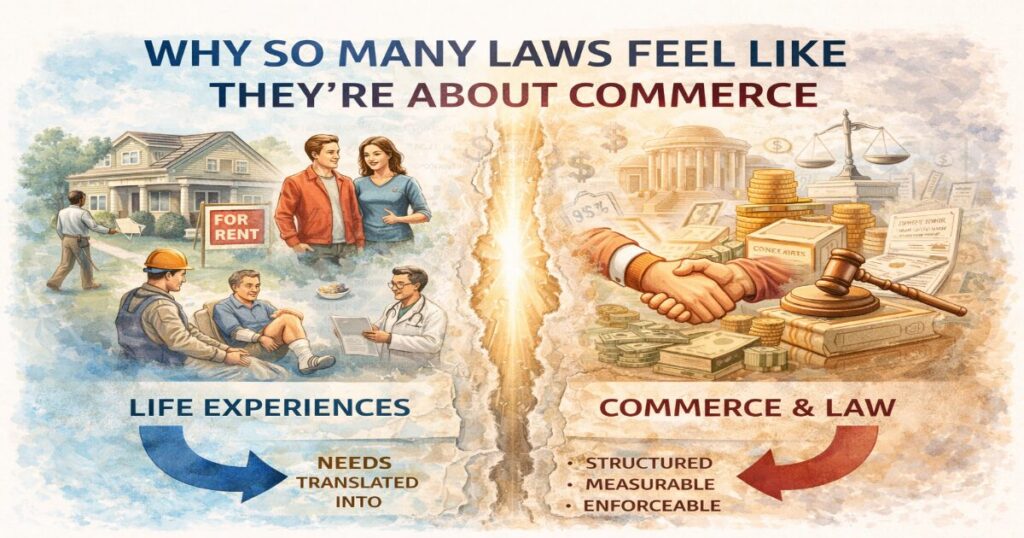
Why So Many Laws Feel Like They’re About Commerce
Most people don’t spend much time thinking about how laws are actually structured. They experience laws in everyday life—paying bills, signing agreements, working jobs, owning property—but rarely stop to ask what ties all of these things together.
At some point, though, a pattern becomes noticeable.
A large portion of modern law seems to revolve around transactions. Agreements. Money. Responsibility. Obligation. And once you see that pattern, it raises a natural question: why does so much of the legal system seem centered around commerce?
In the United States, this isn’t accidental. It’s part of how the system has been built and refined over time.
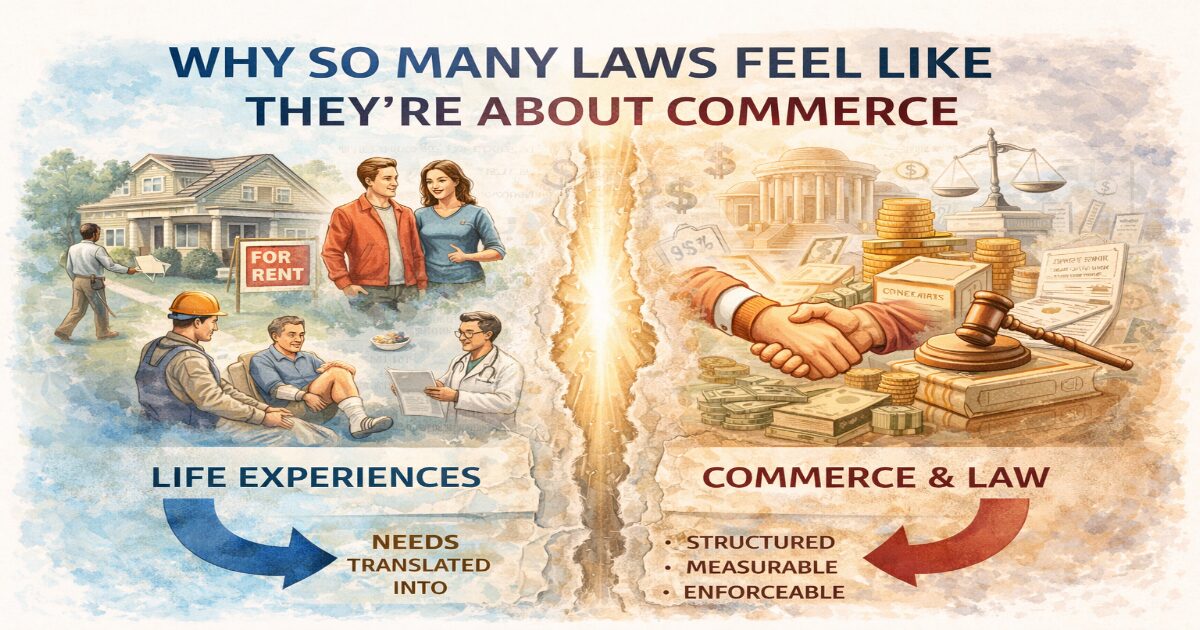
At its foundation, the law needs a way to organize relationships between people. It needs a structure that can define who owes what, who is responsible for what, and what happens when something goes wrong. Commerce provides a practical language for doing that.
Think about how many areas of life get expressed through legal terms:
- Housing becomes a lease or mortgage.
- Work becomes an employment agreement.
- Services become contracts
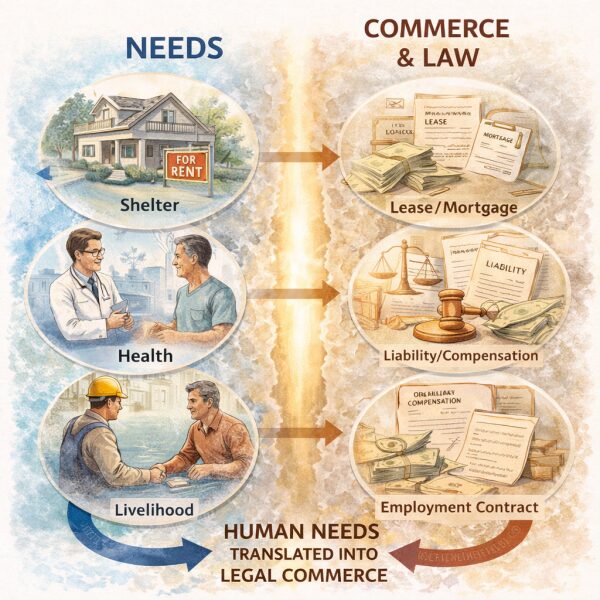
Harm becomes liability and compensation
Even things that are deeply human—like shelter, health, or livelihood—are often translated into structured, measurable forms. That structure usually involves value, and value is often expressed in financial terms.
This is where commerce comes in.
Commerce gives the system a way to measure and standardize. It allows agreements to be written clearly. It allows disputes to be resolved with defined outcomes. It allows responsibility to be assigned in a way that can be enforced. Without that framework, the system would struggle to operate at scale.
But there’s another side to this.
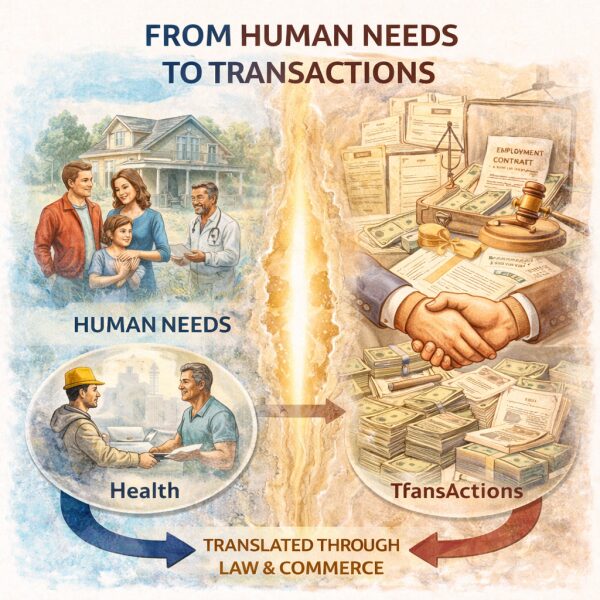
When human experiences are translated into commercial terms, something changes. The situation becomes more structured, but it can also become more impersonal. What started as a human need—like having a place to live or access to care—gets expressed as a transaction. And transactions, by nature, focus on exchange rather than experience.
This is why the system can sometimes feel distant.
It’s not necessarily because it ignores human needs, but because it processes those needs through a specific lens. That lens is built around agreements, obligations, and outcomes that can be defined and enforced. In other words, it speaks the language of commerce.
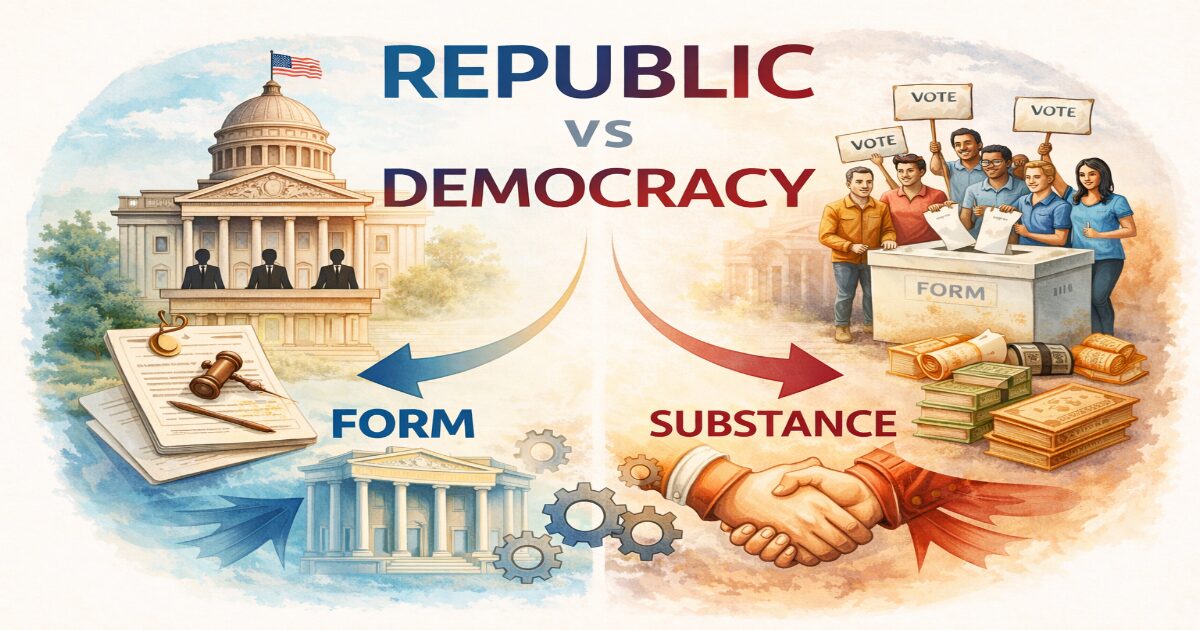
This connects back to the idea of form and substance.
In form, laws often appear neutral and balanced. They are written to apply broadly and fairly. They outline rights, responsibilities, and procedures. But in substance, many of those laws operate through financial and contractual frameworks. The practical application often comes down to what was agreed upon, what can be proven, and what can be compensated.
Understanding this helps explain a lot of everyday experiences.
It explains why resolving a problem often involves payment or settlement. It explains why agreements matter so much. It explains why documentation, terms, and conditions carry weight. The system is built to recognize and enforce structured relationships, and commerce provides the structure it relies on.
That doesn’t mean everything is about money. It means that money and exchange are tools the system uses to manage complexity.
A more grounded way to see it is this: many laws are not created only for commerce, but they are organized through commercial principles. Those principles make the system workable, but they can also shape how outcomes feel.
For some, this creates frustration. For others, it creates clarity. Either way, understanding the framework removes a layer of confusion. You begin to see that the system isn’t random—it’s consistent in how it translates life into enforceable terms.
In the end, the law is trying to do something very specific: create order between people. Commerce happens to be one of the most effective ways it has found to do that. But recognizing that lens allows you to see both sides—the structure that keeps things functioning, and the human experience that exists underneath it.
And once you see both, the system becomes easier to understand, even if it doesn’t always feel personal.